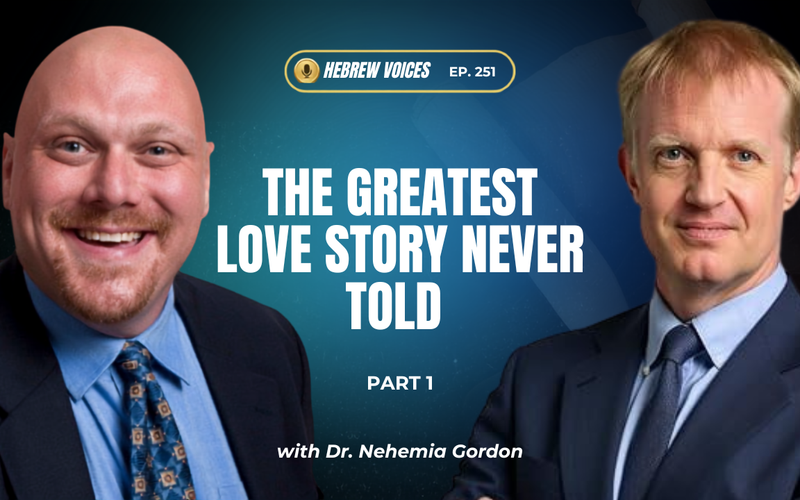
Hebrew Voices #251 – The Greatest Love Story Never Told: Part 1
with Dr. Douglas Hamp
In this episode of Hebrew Voices #251 - The Greatest Love Story Never Told: Part 1, Nehemia is joined by Dr. Douglas Hamp, pastor of The Way Messianic Congregation, as he recounts what he sees as “God’s hidden love story” in the Bible, contrasting traditional Replacement Theology and Dispensationalist narratives with a third view focused on the reunification of the two ancient houses of Israel, which he likes to call “Commonwealth Theology.”
I look forward to reading your comments!
Related Verses
- Ephesians 2:11-22
- Hosea 1:6-7
- Exodus 19-24
- Exodus 32
- 1 Kings 11-12
- Jeremiah 3:8
- Hosea 2:16-25 (v. 14-23 in English)
- Deuteronomy 24:1-4
- Romans 7
- Romans 3:31
- Ezekiel 37
- Colossians 2:14
- Deuteronomy 22:11
- Romans 9
- Jeremiah 16
- Romans 11
- Genesis 48
- Jeremiah 31:31-37
- Genesis 15, 17
- Matthew 23:39
- Acts 4
- Psalm 118:22-23
- Isaiah 28
- Acts 15
- 21:25
- Numbers 25
- John Chrysostom, Discourses Against Judaizing Christians 1.5
- Life of Mar Aba
- Leviticus 10
- Preamble to the US Declaration of Independence
Referenced Links
- God's Divorce: The Bible's Hidden Love Storyby Douglas Hamp
- Corrupting the Image trilogyby Douglas Hamp
- Commonwealth Theology Essentialsby Douglas Krieger, Douglas Hamp, Gavin Finley, Chris Steinle
- Dr. Douglas Hamp Haunted Theology -How the Ghost of Marcion Haunts the Modern Church | Dr. Douglas Hamp
Books Mentioned
- God's Divorce: The Bible's Hidden Love Story by Douglas Hamp
- Corrupting the Image trilogy by Douglas Hamp
- Commonwealth Theology Essentials by Douglas Krieger, Douglas Hamp, Gavin Finley, Chris Steinle
Audio TranscriptRead moreShow less
Dr. Douglas Hamp: We have, basically, missed the boat, because we thought the Old Testament was not important; again, thanks to Marcion. We were told that we replaced Israel. We were told a lot of different things. And dispensationalism then comes along and says, “No, no, no, no. We didn't replace Israel; God still loves Israel.” So, I think dispensationalism gets a few points for trying to get us back on the right track. I just think we stopped too soon. And I think, you know, in my opinion, God is opening our eyes, and we're beginning to see this bigger picture; that it's not Israel versus the church, it's Israel. The whole story, from Genesis 12 till Revelation 22, the whole story is about Israel. And it's not about the church replacing it, it's about this promise, this people that God established, the breakup of this relationship and the restoration of this relationship.
--
Nehemia: Shalom, and welcome to Hebrew Voices. I'm here today with Dr. Douglas Hamp. He's the author of over 15 books. He's the pastor of The Way congregation in Denver, Colorado, where I've spoken. He has a PhD from Louisiana Baptist University, graduate of Hebrew University of Jerusalem's Rothberg International School, where he got an MA in Hebrew Bible. Today, we're going to talk about a recent book of his that came out, God's Divorce, which was published in 2025. But he's most famous for his Corrupting the Image trilogy which was based on his PhD dissertation at Louisiana Baptist University. Shalom, Doug.
Doug: Hey, Shalom, thanks for having me.
Nehemia: Yeah, thanks for coming on the program. And we kind of did this last minute. So, God's Divorce; let's start with what they call the elevator pitch. You know, the young people say TLDR; too long, didn't read. So, give me, like, the 60-second version, and then we'll go into some more detail.
Doug: Yeah, well, the 60-second version is basically that the gospel, as we have so often heard it, is a bit incomplete because really it goes back to Israel. God and Israel got married, God and Israel got divorced, and God promised that he would restore His relationship with Israel. And in order for that to happen, He had to disavow, He had to annul that first covenant, the old covenant, and establish the new covenant. And the only way to make that happen was through his death, burial, and resurrection.
Nehemia: All right. So, that's what your thesis is, I suppose. How does that differ from what Christianity has generally taught over the last 2,000 years? There's been some changes. We're actually recording this a few days after there was a mass excommunication in the Catholic Church, partially over this issue. Meaning, one of the ideas of the Vatican II Council in the Catholic Church (and I know you're not Catholic, right, but just for the general audience here) is that the Jews, up until Vatican II, were blamed for the death of Jesus, and were a cursed people and no longer had any relationship with God. And Vatican II kind of modified some of that. And then there's a group within the Catholic Church (well not anymore, right) that, until a few days ago was within the Catholic Church, saying, “We reject Vatican II.” And part of that is, God has no relationship with the Jews. The Jews are cursed, the church replaced the Jews, or replaced Israel.
Doug: Yeah.
Nehemia: So, how does your position differ from what's commonly known as replacement theology or the fancy word of supersessionism?
Doug: Right.
Nehemia: That is, the new covenant replaced the old covenant, and the church is the new Israel, and the Jews are now… the Jews are just another nation like Albania.
Doug: Right, exactly. And I think the church at large has missed the big picture. So, I grew up dispensationalist, and we kept the Jews over there, and the church was over here; never the twain shall meet, of course. And yes, God loves the Jews, but for the moment, He's not really talking to them, and you know, He's all lovey-lovey with the church.
Nehemia: So, that's different from replacement theology. Explain…
Doug: It's different. Very different.
Nehemia: Explain dispensationalism, because I think a lot of people are confused about how that differs from replacement theology.
Doug: Absolutely. So, replacement theology has been around a lot longer. Dispensational theology is the new kid on the block. You could look back to Darby, you could look back to C.I. Schofield, especially Schofield, and this whole idea that there have been seven dispensations as to how God is operating in this world. You had the Age of Innocence, then you had the Age of Abraham, when God is working through the patriarchs, and then the most important are the Age of Law, when God presented the Ten Commandments, et cetera, and the Jews said, “Okay, yes, we'll do this.” And then came the Age of Grace, when Jesus came to free us from that Age of Law. Wasn't that nice of him? And we've been living in this Age of Grace ever since. And then He's going to rapture the church, take us out, and then He'll turn His attention back to the Jews and the tribulation, and then the millennium, and then the eternal state. So, those are the seven dispensations. And I…
Nehemia: Are most Protestants in America dispensationalists, or a large percentage?
Doug: Well, it's certainly a large percentage. Anybody that is basically Baptist would probably fall in that camp. A lot of evangelicals generally fall in that camp, though they may not know that they're dispensationalists. A lot of them never heard the term, but that's basically what their pastors are teaching for the most part. Anybody from Dallas Theological Seminary is very much of that ilk.
Nehemia: So that’s very interesting whenyou say ilk, because you're making a judgment there, which you're allowed to do. I'm trying to stay out of… I mean, like, as a Jew, I'm trying to be neutral here…
Doug: Right.
Nehemia: …but I am trying to understand the concepts. So, when we hear about Zionist Christians, where they say that, you know, Israel is God's chosen people, and they support the state of Israel; is that usually, or often, dispensationalist?
Doug: Yes. Yeah, that's very dispensational.
Nehemia: So, in other words, God loves Israel, but He doesn't really have… what is it? God doesn't really have a relationship with them anymore? Is that what you would describe?
Doug: Well, I mean, that becomes a little bit of a gray area, but they would definitely say that God loves the Jewish people and they are God's chosen people. But because they basically said no to Jesus, He turned his attention to the church, and the church is basically a parenthesis in God's big plan. And once the rapture happens, then God's going to go back to His original plan, which was basically the Jews.
So, yeah. It’s a little bit strange in that area.
Nehemia: Are generally the people who are pre-trib rapture, are they generally dispensationalists?
Doug: Oh, hardcore, hardcore, yeah.
Nehemia: Okay.
Doug: Yeah.
Nehemia: Like, I once spoke at this church, and it was like, in the middle of nowhere, I think in Florida, or someplace like that, and the pastor introduced the Sunday morning sermon (and I was like, you know, speaking afterwards) with “here's what we believe”, and one of those was pre-trib rapture. And I couldn't quite understand why that was so important. And I still don't, frankly, fully understand…
Doug: Right.
Nehemia: …pre-trib, mid-trib, post-trib. I mean, if you talk to most Jews about the timeline of, you know, let's say of the end times, they've never given it a thought, let alone have a hard and set doctrine about it.
Doug: Right. Yeah. Oh yeah. I grew up very pre-trib rapture.
Nehemia: Mm-hmm.
Doug: And it's this idea that, you know, the great tribulation is coming, it's going to be this horrific time on planet earth, but God is going to rescue His people. He's going to snatch us out of here before that time begins. We're going to be caught up, ascend into the air to be with our Lord, and then the worst time in human history is going to start to happen.
Nehemia: And where are you on that spectrum of pre-trib, post-trib, and mid-trib? Or are you on that spectrum?
Doug: Yeah, I'm definitely post-trib at this point.
Nehemia: Post-trib, okay.
Doug: Definitely post-trib. And this is because I've rethought all of my theology, and my book, God's Divorce, is really at the heart of that. And what I discovered is that we, the church dispensationalists, have left out the most important part. And it was one of these things where, you know, I kept reading it, and I'm like, “Wait a second. I have missed something.” And I think Paul was talking about this.
For example, in Ephesians chapter 2 he says that “You, once Gentiles, were strangers from the covenants and promises, and you were excluded from the commonwealth of Israel.” And he's saying, “You're not anymore. Now you are fellow citizens with the saints of God.” And, you know, I'm just like, oh my goodness, I'm like hearing this for the first time.
And then all these things started to come back to me. I remember studying about the house of Israel, and the house of Judah, and I understood them from a historical context, but I didn't understand them theologically. But suddenly, all these things started to fit into place, and where God has made promises to the house of Israel.
And for example, in Hosea, He says, “I will no longer have mercy on the house of Israel, but I will have mercy on the house of Judah.” And I thought, “Wow, that's a very clear distinction between these two houses; one doesn't get mercy. That's why, you know, Hosea has to name his kid, Lo-Ruchamah, right, and Lo-Ami.” I mean, He's talking to the house of Israel, and He says, “You're not my people, no mercy, going to scatter you. But one day I'll bring you back. One day I'm going to betroth you to Me.”
And that betrothal language is the same kind of language that we see in the New Testament that Paul uses of the church. But when I was a dispensationalist, I thought that these were completely separate categories. I'm like, “Okay, God has a thing He's going to do with the Jews and another thing He's going to do with the church.” But what I realized is, what Paul was saying in Ephesians is that “I'm no longer a Gentile and I'm not separate from Israel. I'm now part of the commonwealth of Israel.”
Now, this is where people say, “Oh, Doug, you believe in replacement theology.” But I don't. I really don't. I promise you. I do not believe in replacement theology, because I don't think that the church has replaced Israel. I think that I have actually joined Israel, and that there's a massive distinction. And what Paul calls it is commonwealth. You know, well, I and a couple of buddies, we coined the term commonwealth theology, but whatever, it doesn't matter. But Paul is the one who gave us this idea of “you're part of the commonwealth of Israel”.
And once I saw that, my whole paradigm just shattered, okay? And then I could go back and I could understand that the covenant that God established with the united people of Israel back at Mount Sinai was not simply the law, but it was a marriage contract. And, you know, I came to this through my own discovery. But then, it was funny, because I was celebrating the feast of Shavuot and I was doing some research, and I’m reading this thing, I think it's from like aish.com, or one of those, maybe chabad.org or something, and they're like, “Yeah, and the Jewish people have always believed that God and Israel got married at Mount Sinai.” I’m like, what? Like, I didn't know that! Man, I’m so late to the party, it's crazy. You know, and so, God and Israel, you know, they get married. There's a chuppah, right, over Mount Sinai, and God says, “I love you.”
Nehemia: Tell the audience what a chuppah is, and how there's one at Mount Sinai.
Doug: Well, so, the chuppah is basically the wedding canopy. And so, the idea is that you kind of have the clouds up there, or maybe the fire, or whatever, and all of this magnificent glory stuff, and that was basically when God is bringing Israel into His tent, as it were. And they're entering into a marriage contract, a marriage covenant. Out of love, not obligation, not out of duty, not out of “I got to do these laws”, but God's saying, “I love you, Israel, and I want you to be Mine. You're going to be My special treasure.” And Israel replies, “All that the Lord has said, we will do.” You know, they said, “we do”, right? “I do.” They take God to be their God, and He takes them to be His people. And it's all great.
But then, Israel goes after the golden calf, sort of on their honeymoon, and so, basically, from the beginning of this relationship, it's already strained. The people of Israel are going after other gods, and this will continue for the next 700 years. So, we see all throughout the time of the judges, they're going after Baal, Ashtoreth, Molech, et cetera. And then we come to the reign of Saul, David, eventually Solomon, and under Solomon, with all of his many wives, he's going after their gods as well. He's building high places for them. You have the Mount of Corruption there, in Jerusalem, and all kinds of bad stuff.
And so, God finally says, “Okay, Solomon, because of all of what you've been doing, I'm going to split the kingdom, and I'm going to give Israel to somebody else.” And so, he gives it to Jeroboam. Jeroboam is an Ephraimite. He then becomes the king over the northern ten tribes, so, Israel, as it were. Whereas Rehoboam continues (the son of Solomon) he continues over the southern kingdom of Judah. Because God said, “I made promises to David, and I'm going to keep those promises.”
But Israel, as we know it, is no longer part of Judah. It's now its own thing, a separate kingdom. And that happens about 932 BC. And then it just goes from bad to worse, and the northern kingdom of Israel, the ten tribes, they continue to go after false gods until finally God says, “Okay, that's it. You want to go after those other gods? Fine. Here's your certificate of divorce.” Jeremiah 3:8, “I gave backsliding Israel a certificate of divorce.” And, you know, and then Hosea, “She's not my people, I'm not her God. She's not my wife, I'm not her husband. Adios.” Right? And as she's packing her bags and leaving with her certificate of divorce in hand, God says, “But one day, I'm going to betroth you to Me in righteousness. One day I'm going to bring you back.”
So, this now creates a divine dilemma. Because, according to Deuteronomy 24, it says, “If a man has a wife, and he finds some ervat davar, some unclean thing in her, and he gives her a certificate of divorce, sefer kritut, and he puts it in her hand and sends her out of his house, she becomes another man's wife.” And the same thing happens; she cannot go back to the first husband, because that would be an abomination and it would greatly pollute the land.
So, now we have a problem. God said, “Okay, here's your certificate of divorce. Get out.” She goes and hangs out with Baal, Ashtoret, and all these other gods. And then God says, “But I'm going to bring you back.” You can't do that according to the law. And I think this is where Christians in general, for the last 2,000 years, basically, we've kind of missed the boat. I'm going to blame a guy named Marcion for a lot of that, but that's a whole different story. But we have, basically, missed the boat, because we thought the Old Testament was not important, again, thanks to Marcion. We were told that we replaced Israel. We were told a lot of different things. And dispensationalism then comes along, and says, “No, no, no, no. We didn't replace Israel. God still loves Israel.” So, I think dispensationalism gets a few points for trying to get us back on the right track. I just think we stopped too soon.
And I think, you know, in my opinion, God is opening our eyes and we're beginning to see this bigger picture; that it's not Israel versus the church, it's Israel. The whole story from Genesis 12 till Revelation 22, the whole story is about Israel. And it's not about the church replacing it, it's about this promise, this people that God established, the breakup of this relationship, and the restoration of this relationship.
And so, Paul says, in Romans chapter 7, he says something astounding. He says, “You know, brethren, since I'm speaking to those who understand law, brothers, are you unaware that the law has authority over someone as long as he lives? A married woman is legally bound to her husband while he lives, but if her husband dies, she's released from the law of the husband.” And when I read this, I’m like, “Oh my goodness! Paul is talking about Deuteronomy 24.” And he's not just giving a “By the way, here I have this kind of idea about marriage, and I’m going to loosely apply it to Jesus.”
No, I think he's very specifically saying that the wife had been divorced, and she cannot come back, and he's talking to people who know the law. So, of course, somebody who knows the Torah, they're going to say, “Well, of course, I mean, the whole marriage and divorce thing is Deuteronomy 24.” So, he says, “If the husband dies, she's free from that law.” Which law? The law of marriage, the law of the husband. And this is where the church dispensationalists, whoever, have by and large said, “Well, see? We don't have to do Torah anymore, because Jesus freed us from Torah.” And that's when I hear the fingernails on the chalkboard, and I'm like, “No, that's not what he's saying.” Paul even says, in Romans 3:31, “Do we then abolish the law? No, we establish the law.”
Right? So, Paul's not against Torah, but he's trying to explain how the house of Israel and the house of Judah come back together. This, I think, is at the heart of many of his epistles. He's trying to explain how this separation that ended in divorce, can now be resolved, how it's undone. How the death, the obligation, the divorce certificate, that was that handwriting that was against us, is now undone. And it's resolved, and how we come back together.
And so, then he goes on in Romans, he says, “So, likewise, you've died to the law,” again, not the Torah itself, but the law of the husband, very specifically, “through the body of Christ that you may be married to another, to him who has been raised from the dead.” Of course, that's Jesus, right? So, Jesus is the one who died, that's the first husband. And then, the Jesus who rises is now, albeit the second husband, same husband, but legally he's now a different entity in a sense.
And this is, I think, at the heart of all of this. And I think Paul was just like, “Guys, do you see how this is all coming together? This is the fulfillment of Ezekiel 37, talking about the two sticks, the stick of Israel and Joseph and the stick of Judah, and he's going to make them one in his hand.” But when I was a dispensationalist, I thought, “Well, that's really interesting, that's really cool what God's going to do for the Jews.” And, you know, it took me a long time to understand that.
And part of the cognitive dissonance was that I had always heard that Jew equals Israel, Israel equals Jew. And I thought there was no distinction. But of course, we know there's a distinction. I live in Colorado, and I'm American, but not all Americans are Coloradans, right? I mean, that's pretty obvious, right? So, you know, New Yorkers, they're Americans, Texans, they're Americans, and we have to understand that, yes, all Jews are part of greater Israel. They’re a part of greater Israel, but not all Israel are necessarily Jews. And that's because in our nomenclature, we've lost these distinctions between the house of Judah, the house of Israel; that's Old Testament stuff. We don't have to worry about that stuff.
But we do, you know, and because we haven't paid attention very well… I mean, sometimes we've tried, but we've just been, I don't know, confused about some of these terms. And so, then we come to the New Testament, and we think, “Oh, there's this whole new program, and Paul's saying I don't have to do the Ten Commandments anymore, and Jesus freed me from the law.’” So, that's what I'm getting at. I think that's the big story. I think that's the forgotten love story of the Bible, and it reframes the whole thing.
It's not that, you know, God's like, “Well, those Jews, they just didn't accept Jesus, so to hell with them, you know, I'm going to go to this new chick called the church.” No. It's the same bride, the same wife that God had who was unfaithful, who went after other gods, who sacrificed children to Molech, who gave Him the middle finger. And that one that completely sullied His name, God says, “But I still love you. I'm a little bit mad right now, but I still love you, and I'm going to fix this.”
And so, he comes, and for that wife, he dies. For that wife, he goes to the cross. For that wife, he then resurrects so that he can take her and now they can have this new thing, this new covenant. And when you see that the old covenant was a marriage contract, the new covenant is a marriage contract. And within both of them; Torah. Right? God's instructions are still at the heart.
And so, this is the other thing, that many Christians equate the old covenant as the same as Torah. And I strongly disagree with that. I would suggest that the old covenant was the ketubah. That was, you know, the agreement of our marriage, okay? And the agreement, in a sense, is probably going to be the same in many marriages. You know, if you get married one time, you have your, for better, for worse, and sickness and health; you're going to use those vows. And let's say that that marriage doesn't work out, now you get married to a new woman. You'll probably use the same vows, because the vows are great. The problem was…
Nehemia: Tell the audience what a ketubah is, because I think that then goes in towards the writing, maybe, that's nailed to the cross. Or… I’m not really sure where you're going with it… Tell them what a ketubah is and how it fits into this model. And…
Doug: Yeah.
Nehemia: …and I like… you use the phrase commonwealth theology. So, we've got replacement theology, dispensationalism, and you're essentially trying to define and maybe explain a third way…
Doug: Well, yeah.
Nehemia: …which is commonwealth theology.
Doug: If anybody's interested. So, me and three other friends, we wrote Commonwealth Theology Essentials.
Nehemia: Okay.
Doug: But if you want the easier version, I highly recommend my book, God's Divorce. It's the same idea, much simpler…
Nehemia: Before you get to the ketubah… so, I’m going to just give like a scenario here, so people understand what's going on in Deuteronomy 24, and tell me if you agree with this, okay? I'm trying to basically explain your position, in maybe simpler terms, at least for me.
So, Tom marries Sally. They get divorced, and then Sally marries a man named Ba’al. I'll just call him Ba’al. And then, Ba’al’s like, “No, I'm done with Sally.” And now Sally’s like, “I really did love Tom.”
Doug: Yeah.
Nehemia: “I want to go back to Tom.” And what Deuteronomy is saying is, she's defiled for him. That's Deuteronomy 24:4, so he's not allowed to marry her again. And what you're saying is, Tom, whose name in this case is Jesus, or Yeshua, died and was resurrected, and so, that law saying it's an abomination for Tom to marry Sally is now null and void because he's dead, and in the resurrection, he's allowed to marry Sally. Is that maybe a simplistic explanation?
Doug: Yes, yep.
Nehemia: Okay. And I think most Jews hearing this are like, “Well, all of this is just a metaphor and an allegory in Hosea and Jeremiah, and you're taking it too far.” But the verses you quoted from Paul, I think, are justification for saying… and help me out here; most Christians would say Jesus died to wipe away original sin. And it sounds like to me what you're saying is, “No, there was a different purpose than the death of Jesus and his resurrection.” Is that fair to say?
Doug: Yeah. And, you know, of course, I want to be careful not to simplify Jesus' death too much. I think his death did a number of things, but one of the majors, right? Because there's the whole thing of decay, corruption, death itself. And I think his death took care of a cosmic problem as well. But we'll leave the cosmic stuff aside for just a second.
I think a lot of what Paul is focusing on is not the cosmic stuff, but on this relationship between God and Israel. For example, in Colossians 2:14, this is one of these classic passages that Christians will use. He says, “You who are dead in your trespasses and uncircumcision of your flesh, God has made alive together with him, having forgiven us all our trespasses by canceling the record of death that stood against us with its legal demands, that is set aside, nailing it to the cross.”
All right. So, I don't have the meme right here, but in one of my studies I show this guy who has this meme, and it has Jesus on the cross, and the Ten Commandments, the two tablets of the Ten Commandments, are nailed behind his hands. And I'm just like, “Oh, that makes me ill.” Right?
Nehemia: Don't most Christians say it's the Torah scroll, in a sense?
Doug: Yeah!
Nehemia: Meaning…
Doug: Yeah.
Nehemia: Meaning, with the exception, maybe, of the Ten Commandments.
Doug: Yep, yep.
Nehemia: Or nine of the ten anyway. Meaning, in other words, where it says in the Torah, I don't know, let's take the most famous one Christians love to say, “mixed fabrics”, which is nowhere in the Torah. It's actually specifically wool and linen, which… we could do a study on that.
Doug: Yes. Indeed.
Nehemia: Sha’atnez. So, wool and linen (the prohibition of wearing a fabric that's made out of wool and linen) most Christians say that's done away with. There's no problem whatsoever, because that was nailed to the cross. And what are you saying, instead, was nailed to the cross?
Doug: I'm saying the divorce certificate was nailed to the cross.
Nehemia: Okay.
Doug: That was the ordinance that was against us, that was contrary to us, that did not allow us to come back into covenant relationship with God. And when you start looking at the writings of Paul through this other lens, it all just comes into focus. Because in Romans chapter 9, where he's talking about, you know, he says in Romans 9:24, he says, “Even us whom he has called, not from the Jews only, but also from the Gentiles. As indeed,” he says, “in Hosea, those who were not my people, I will call my people. And her who was not beloved, I will call beloved.”
Now, when I was a dispensationalist, I was believing in the pre-trib rapture and all that stuff. I read this and I'm like, “Oh, Paul is going back to Hosea. He just needs to find a little soundbite to kind of prove his point.” Right? But then when I came into commonwealth theology, I said, “Oh, my goodness. I completely misread that. Paul is not just trying to proof text his point. What he's doing is, he's explaining how the house of Judah, that became a non-people that was assimilated, swallowed up, became part of the Gentiles.” He's saying, “Look, this is what happened; the house of Judah became a non-entity. They stopped existing. What happened to them? They became part of the Gentiles.”
And so now, how does God bring this back together? Well, we still have the house of Judah. They exist as the Jews. But the house of Israel, how is God going to resolve that? Well, they're the Gentiles. And so, when a Gentile puts their faith and trust in Jesus, they become part of the commonwealth of Israel.
And now, where he says, “To those who have said that you are not My people, now you are My people.” You know… so, he says that in Romans, he says it in Ephesians, he talks about it in Colossians. He sort of alludes to it in Galatians, to some degree. But this is the underlying message of Paul's epistles. Not the pastoral ones so much, but these real dense theological ones. Paul's trying to explain how the promises that were made to the house of Judah and the house of Israel, how these are now put back together through Jesus.
But we in the church, we’re like, “Oh, that's not for us. That has nothing to do with us.” And that's how I used to read it. Again, I knew about the house of Israel; of course I did. I studied that. But theologically, it meant nothing to me. I just thought, “Oh, that's just ancient history. That's for the Jews and all that stuff. I'm the church.” But now I realize, “Oh, I'm not the church. I'm grafted into Israel.”
And when you start to look at Jeremiah 16, he talks about the two trees. And he's talking about the house of Israel and the house of Judah. He's talking about the olive trees very specifically. Paul talks about the olive tree. Or let's take Romans chapter 11, where he talks about the fullness of the Gentiles. Again, as a dispensational pre-tribulation dude, I used to think, “Oh, when the last person on earth gives their heart to Jesus, then he will come back.” But now, I'm like, “Oh, my goodness! How did I miss this? He was actually saying, melo ha’goyim. He was saying the fullness of the Gentiles.” And of course, that is a prophecy that Jacob gave when he was blessing Ephraim and Manasseh. But you know, obviously, you know the story, right?
Nehemia: Tell the story to the people…
Doug: Jacob's supposed to put his right hand on the head of Manasseh, right? But what does he do? He puts it on the head of Ephraim! And Joseph's like, “Dad, what are you doing?” And Jacob's like, “I know, son, I know. I might be blind, but I know what I'm doing.” Ephraim is going to be melo ha’goyim. And so, when Paul is talking about that, he's talking about this prophecy that was given. And so, when he says, all Israel will be saved, how did I used to read that? “All the Jews, somehow, are going to eventually put their trust in Jesus.” That's how I used to read it. But now I read it, “Oh, he's not talking about every last Jew believing in Jesus. What he's actually saying is all Israel, house of Judah, house of Israel, and they're going to become all Israel, like they used to be all Israel.” Right?
But we've divorced ourselves from the Old Testament. “Oh, that's Jewish stuff. We don't have to do that. We're not into Torah.” And so then, of course we're incredibly confused, and we don't understand Paul's writings because we haven't taken time, by and large, to appreciate the front of the book, to understand the foundation. And then we come up with a lot of wackadoodle kind of doctrines. And, sadly, we develop anti-Semitism; we think the Jews are the problem. You know, Jesus freed us from that Jewish stuff. He freed us from the Torah. And on and on the list goes.
Nehemia: Well, all right, there's lots to talk about here. So, we brought up ketubah, and I want to circle back to that. So, in Deuteronomy 24:1, and I’ll give you my perspective here and you can tell me if you disagree with some of it. So, in the ancient world… you know, we have this idea in America called common law marriage, which is, you proclaim to the community, “this woman is my wife”, and you live with her in your house. In Texas, for example, that's the law; not in every state.
In the Torah, let's say, in the time of Moses, as far as we know, there was only common law marriage. And if you kicked the woman out of your house, she then needed something, some proof, that she was now free to marry another person. Because otherwise she's going to be stoned. So, that proof was this sefer kritut, which is literally a scroll of divorce, or a document of separation. And she would then have that piece of leather with the writing on it that says that “Well, look, he separated himself from me, so you can't say I’m committing adultery. I’m now with a different husband.”
Also, over time, developed this idea of a ketubah, which was a marriage contract, which would give the woman certain rights so that she's not just kicked out in the street with nothing. But she generally has… it's sort of like a prenup; that's how it developed historically, at least, where she's guaranteed 2,000 zuz, whatever that is. You know, it's some amount of money. So, how does that ketubah, the marriage certificate… which isn't in the Torah, but it definitely is something that developed within Jewish culture, and it was likely around in the time of Yeshua, so I see how you could then bring it into the constellation of what Paul is talking about. So, how does that play into it? How does that fit in the whole scheme of things, this ketubah, this marriage document?
Doug: Yeah. Well, so, the reason I brought that up is because many Christians, at least the ones that I know, they assume that the old covenant, the Mosaic covenant, the Sinaitic covenant, that thing is the same as God's instructions, His Torah. And I'm saying, no, they're two different things. And when it talks about the Book of the Law, or… you know, some of these terms are not a hundred percent, you know, precise. But the idea here is that, when it talks about the old covenant, that was where God and Israel entered into this marriage contract, for lack of a better word. And it was a brit. It was, “I'm promising to love you, you're promising to love me.” We can call that a ketubah. I know that's anachronistic, but it still holds. It has a nice picture.
And so, then, the new covenant is going to be a new marriage contract, but Torah will still be part of it, right? Because in Jeremiah, he says, “Behold, the days are coming when I'll make a new covenant with the house of Israel and the house of Judah, not according to the covenant I made with their fathers when I took them by the hand to lead them out of Egypt, My covenant which they broke, though I was a husband to them. But this is the covenant I'll make with the house of Israel after those days that I will write it on their hearts and put it in their minds.” Right?
So, His instructions are part of both covenants, both the old covenant and the new covenant, the Sinaitic covenant and this new covenant. And so, you know, for me as a Torah-keeping messianic teacher, I'm constantly trying to explain to people that, “Look, we're not trying to keep God's commandments to be saved. We believe we're part of the new covenant by His grace, by His goodness, His mercy, undeserved. But yeah, we want to also do what He said to do, you know?” And yet, for most Christians, there's this huge block. You know, “I'm not in Old Testament covenant.” I'm like, “I'm not either,” right? I'm not. But the Old Covenant is not the same as Torah. It's not the same as His instructions. Does that make sense?
Nehemia: So, am I understanding correctly? So, Jeremiah 31:31 is the verse you're talking about. It says, “Behold, days are coming, says Yud-Hey-Vav-Hey, and I will cut for the house of Israel and the house of Judah a brit chadasah, a new covenant.” And you're saying that's a new marriage contract? Meaning…
Doug: Yeah.
Nehemia: …the first one was at Sinai where He says, “You're under the chuppah with Me, under the clouds, and we're entering into a marriage covenant.” That might be metaphorically, but fine. And you're saying that new covenant is through Jesus, through Yeshua, for those who are now taking on the role of Israel? Meaning, the house of Israel and Ephraim, is that the idea?
Doug: Yeah. I mean, so, He says there in verse 32, “The covenant I made with them, though I was a husband to them.” So, they broke that covenant. So, that's the law of the husband that Paul was referring to in Romans chapter 7. Israel and God, so, all Israel in that case, they entered into this marriage contract with God. They then went after other gods. That was the big no-no, right? It wasn't that they weren't perfect. Nobody's perfect, but they went after other gods.
And, you know, I've thought about why did God love King David so much? King David was a murderer, he was an adulterer, he did a lot of bad things, but he always stayed faithful to God. Even though he screwed up, he was faithful to God. Whereas as his son went after other gods, and that was the straw that broke the camel's back, right? That was the bridge too far, and that's why God said, “Okay, fine, we're done. You know, I'm going to split the kingdom, et cetera.”
So, yeah, both covenants (old covenant, new covenant) are marriage contracts. And yeah, that's what I'm getting at.
Nehemia: Okay. So, since the 90s, there's been this idea among, and I'm just going to use the broad term here; you use the word messianic. I found many people who you or I might define as messianic reject that term. There's other terms out there. Hebrew roots, which is vehemently rejected by many people.
Doug: Yeah, I know.
Nehemia: Because it encompasses all kinds of… I think you used the word, wacky things. So, I don't know what term I'm going to use. Torah-keeping Christian. Would that offend you if I use that term?
Doug: That’s perfect. That's perfect.
Nehemia: Okay. So, in the Torah-keeping Christian movement, or let's say, very broadly, here, I'm saying there's been this idea called the two-house theology, which often, but not always, had a tie-in (and I'm talking since the 90s), in some formulations of it, with British Israelism. So, how does commonwealth theology relate to the so-called two-house theology, at least as I very poorly understand it? Let's put it that way.
Doug: Yeah. Yeah. We really try to stay away from any kind of genetic discussion. I mean, maybe we have pet theories, but we don't talk about them publicly, because it's kind of a bridge to nowhere, you know? The whole genetics discussion; then it becomes about British Israelism or, you know, is America Ephraim and or Manasseh and… who cares? You know, I just think…
Nehemia: I have this great story I love to share. I was traveling around in 2005 doing a speaking tour, and during one, like, seven-week period I spoke in 21 different places, 21 cities. So, I'm somewhere in Ohio, and I meet this guy (I think it was Ohio), and he's telling me this elaborate theology he has. And he's a hundred percent British Israel, right? And it was something, like, I don't remember the details because it was over 20 years ago, but it was something like, you know, I don't know, “Yom Kippur is going to be this event in history, and then America is Ephraim, and the United Kingdom is Menashe.” And then I was later in Washington State, and I meet another guy who tells me… I said, “This sounds like the same story that other guy said.” He said, “Oh, no, that's completely different.” He says, and I could be getting it backwards, but he said something like, “Oh, no, he's completely different. America,” he says, “is Ephraim, and UK is Menashe. And I say the opposite! America is Menashe and the UK is Ephraim.” And I'm like, “Oh, boy.”
Later, I learned the terminology… Freud had this term called the narcissism of small differences, which I think is actually really profound…
Doug: It is, it’s very profound.
Nehemia: …which is this idea that the closer someone is to you, the more the small differences matter. Like, I can have this conversation with you without any problem, but if I get together with another Karaite Jew who has a different definition of, I don't know, when Shabbat begins, I'm his mortal enemy and he wants nothing to do with me.
Doug: That's right.
Nehemia: And I'm like, “Guys! What are we talking about here? Seriously?” And I think we talked at the beginning of this segment about the Catholic Church. You just had some split about something that, as a non-Christian, I'm like, “What do you guys even talking… Wait, what guys? What? Like, it's about whether the mass is in Latin, or you have a choice whether it's in Latin or your local language. That's really what you guys are splitting over?” I mean, I'm not a Catholic, so, I understand it's a big deal to them, but I really think it's the narcissism of small differences. I think it's worth acknowledging that. Right?
Doug: A hundred percent.
Nehemia: At the same time, like, “Yeah, that guy is my moral enemy! He begins Shabbat in three stars, not at sunset!” Like what, guys? Can we grow up and get past that? But look, it's human nature as well. So, all right, there's this island in the Indian ocean called North Sentinel Island, where the people have had contact with the rest of the world, but not in a language that anybody can understand. So, in my scenario, there's somebody from North Sentinel Island who drifts away on a boat, and he lands in India, and he learns about Jesus. And he says, “Okay this makes sense to me.” Why does he need Jesus to die to renew the covenant? His ancestors on North Sentinel Island never heard of Sinai, never heard of the Jews, never heard of anything in the Old Testament or the Commandments. They've been cut off for… I mean, the secular scholars say 10,000 years; let's not get into whether it's 10,000 or since the flood, right? Or since the scattering of the languages. They don't have any language in common with anybody today. Why does he need the death of Jesus to come into covenant with God?
Doug: Yeah.
Nehemia: The North Sentinelese man.
Doug: Right. Well, you know… and again, this is where I would definitely say that you don't have to understand all the theology, at all.
Nehemia: Okay.
Doug: Right. I don't think that that's any kind of a prerequisite. But, you know, if we are in the Bible story, then we might as well understand the biblical story, right? So... You know, for that man, I would just say, “God loves you, and He wants to have a relationship with you. You know. And Jesus is the door.” Amen, okay. Now, as he continues to study, like, well, why is Jesus the door? Okay, glad you asked, okay? This whole thing is the story of Israel. God promised that He would make Abraham a great nation, and that all the nations would be blessed through him, right? So, it's not through this thing called the church. It's through Abraham, Isaac, Jacob. And then, God makes lots of promises to the 12 sons of Jacob. He then makes promises to David, He makes promises to Judah, et cetera. And then He makes this promise to the house of Israel, that “I'm going to bring you back. I'm going to betroth you to Me in righteousness.” But what happens to them? They become a non-entity. They become generic. They're like everybody else. They become part of the nations.
So, when the house of Israel becomes part of the nations, part of the Gentiles, the goyim, then anybody from the goyim who then puts their faith in Jesus, they get put into the house of Israel/Ephraim category, if you will, and that is how they have a covenant place at the seat, if you will, into God's kingdom. So, you know, again, that guy from Sentinelese, whether he understands any of that doesn't matter. But God certainly understands it, and God has it all figured out, and, you know, that's why I don't get into the genetics, because, like, you know what? I think that's a waste of time, quite frankly.
But, you know, as far as your standing, this is how it's going to be. Think about the erev rav, the mixed multitude that came out of Egypt. They did not remain an erev rav. They did not remain this other group. They all assimilated into Israel. Some probably became part of Judah, some were part of Asher, some were part of Simeon, some were Benjamin, you know? And they just became part and parcel of the nation of Israel. Great. And that's where I see myself. I'm not remaining over here in this thing called the church, or a Gentile. I become part of the nation. I'm given full citizenship. I don't replace Israel, I just become one of you, you know?
Nehemia: What is the role of the Jews now, in your worldview?
Doug: Well, so, this is where we have the house of Judah and the house of Israel. And this is the two sticks that are coming back together. I think, legally, Jesus took care of all the legal paperwork at the cross. Now, practically, we don't quite see that 100% yet, but, you know, eventually it will happen. And I think that'll probably happen at the second coming of Jesus. But legally, it's all in place so that the two houses can come back together. So, I still think the house of Judah has a huge role to play, and that takes me into a whole different area of study. This has to do with the covenant of death. I'm going to try to do this standing on one foot, okay, be’regel echat.
Nehemia: Okay.
Doug: Or in a nutshell, for our American counterparts here.
Nehemia: Yeah.
Doug: But, so, in a nutshell, basically, Jesus gave an ultimatum to the leadership of Jerusalem. He said, “You will not see me again until you say: Baruch haba b’shem Adonai.” So, when the descendants, the legal corporate descendants of the Pharisees, of the scribes, we can call them maybe Sanhedrin, maybe the Knesset, maybe the Rabbinate of Jerusalem, take your pick. I'm not going to die on that hill. But whatever constitutes the builders that rejected the chief cornerstone. And Peter lays that at the feet of the leadership in Acts chapter 4. He says, “You were the builders, and you rejected the chief cornerstone.”
So, the builder people, which would constitute the leadership of the house of Judah, they have to accept, or respond to, the ultimatum that Jesus gave. When they say, “Baruch haba b’shem Adonai”, that's when Jesus is going to come back. So, man, we need the house of Judah more than ever, okay? I mean, I’ve prayed a thousand times for Jesus to come back, and, well, he hasn't come back yet. But he said when he's going to come back; when the leadership of Jerusalem cries out, “Baruch haba b’shem Adonai”, as stated in Psalm 118, right? That the stone that the builders rejected has become the chief cornerstone. This was the Lord's doing, and it's marvelous in our eyes. You know, and so...
Nehemia: And that's from the Psalm, by the way.
Doug: Yeah, that's from Psalm 118. You know, and so, this is where the church has said, “Oh, the Jews rejected Jesus so they're in big trouble.” And I go to Psalm 118, I'm like, “Well, I don't know exactly why they rejected him, but it says it's the Lord's doing.” How does he work that out? I don't know. He's God. He'll figure that one out. But for one reason or another, the leadership rejected Jesus, okay? It doesn't mean that all Jews are bad. Hardly. I mean, there were so many Jews that believed in Jesus, and God loves them. And so, I'm a hundred percent on board with God loving the Jewish people. They’re still massively important; they’re still a huge part of the plan, a central part of the plan, in fact. And so that has to happen.
But that's where I get into that, in Corrupting the Image, Volume 3. I've got another book called Immortal Dawn coming out really soon, and I talk about the covenant of death, the brit mavet spoken of in Isaiah 28. But again, that's kind of a different story.
So, yeah, the house of Judah is still massively important. God's going to put the two sticks back together. So, that is the house of Judah, the Jews, and the house of Israel, Ephraim, us Gentiles, putting us back together. And so, now when Paul talks about, he's going to make one new man out of the two, that's in fulfillment of Ezekiel 37, where he says that the two sticks will come back together. They will not be two nations ever again. They will be one nation. They will no longer be divided. Again, we don't see that practically happening yet, but legally there's nothing standing in the way. So…
Nehemia: And that's kind of consistent with… and I never understood this in mainstream Christianity's view, like where it talks about the one new man, and there's no longer Jew and Gentile, and yet in their theology, “No, the Jews are rejected, and we're the new Israel. We've replaced…” Well, wait a minute. That's not what Paul seems to be… or what it says there, in that epistle there.
Doug: Right.
Nehemia: So, recently I interviewed a gentleman who's a scholar, and his argument was this… and he's a Christian. He was saying that, no, Jesus didn't do away with the Torah. He wasn't antinomian, and we're talking about Mark 7 and Matthew 15… we don't have to get into it. But basically, his argument was that linguistically, you can make a strong case that Jesus wasn't doing away with the ritual commandments of the Torah. So, I asked him after the interview, I said, “So, do you eat pork?” And he's like, “Yeah, why wouldn't I? The Jerusalem Council, Acts 15.” So, what's your answer to that?
Doug: Oh. [Laughter]
Nehemia: Acts 15, Acts 21, the Jerusalem Council.
Doug: Oh, yeah.
Nehemia: He's like, “Look, I don't eat blood pudding. I only have to do four things.” Right?
Doug: See, I think that's been terribly misunderstood. Terribly misunderstood.
Nehemia: Explain it.
Doug: I've been doing a bunch of videos about that, et cetera.
Nehemia: Where can people find your videos? We didn't say that, and we'll put it up on the screen as well…
Doug: Dr. Douglas Hamp is my YouTube channel, and yeah, I've been putting out, you know, how Torah is still for today. It's still for us; it's not this oppressive thing. So, let's take Acts 15. So, Acts 15, the real question was, does a Gentile have to be circumcised in order to come into faith, in order to come into covenant? And this was already a 1st century Jewish discussion, apart from Jesus, that was happening. And so, you have the Alexandrian, the more liberal Jews, who were saying, “No, all you have to do is come by faith, man. You just have to raise your hands in gratitude to heaven. Come as you are, and you will learn on the job.” And the more stringent school was saying, “No, no, no, no. You first have to keep Torah, and then we'll see. We'll have a little review time to see how you're doing, and then maybe you can become part of Judah.”
So, this discussion about, how do you become part of the covenant, was front and center in their minds. And so, the Jerusalem Council says, “Hey guys, what are we doing here? You know, our fathers couldn't keep Torah in order to come into covenant. You come into covenant and then you keep Torah. And you're learning. And that's why Moses is preached and taught every Shabbat in every synagogue.” Moses, of course, being the Torah.
So, what they're saying is, if you are a new convert and you're going to believe in the God of Abraham, Isaac, and Jacob, what would be antithetical to believing in the God of Abraham, Isaac, and Jacob? Well, believing in other gods and worshiping those other gods. So, those four things that they were talking about, that you have to stay away from idolatry, from things strangled, from blood, and from sexual immorality, which is a very broad and vague term, okay? The actual Greek there is porneia. And porneia, as we go back to Numbers chapter 20, when the Israelites really messed up at Baal Peor. Certainly, the boys and the girls were doing some hanky-panky, but it wasn't simply about hanky-panky. It was in worship of the god of Peor, of Baal Peor, and that is why God got so upset. It's because they were… I mean, just in His face, worshiping this false god right in the Tent of Meeting, in fact. And so, porneia is very closely tied to Temple prostitution.
So, when you look at those four things; no idolatry, obviously, and then, things strangled and blood, that has to do with idolatry as well, and then Temple prostitution. So, if you're going to believe in the God of Israel, well, obviously you cannot do these things. That's the baseline of what you have to do in order to become a follower of the God of Israel. All right?
Now, are those the only things? Well, of course not, and no Christian really believes that. They just want to be able to eat their blood, or whatever, which is a whole different story.
Nehemia: Well, his argument was, I only have to do those four things. So, he said, “No, I don't eat blood pudding. I don't eat blood,” which is the actual thing, blood pudding, right?
Doug: I know, it’s disgusting…
Nehemia: But he's like, “Other than those four things, I’m not bound by the ritual things or anything that Jesus reiterated as well.” I guess he’s… So, I want to share my screen here real quick. And we don't have to solve this problem, but I think it's… more people need to comment on it, on my view. So, here in the King James Version, in Acts 21, it says, “As touching the Gentiles which believe, we have written and concluded they observe no such thing,” and the context here is the commandments, “save,” meaning, except, “only that they keep themselves from things offered to idols.” And when you look in the Nestle-Aland 28, it doesn't have that “save only”, and most modern translations also don't have these words, “save only”. There's a textual variant in some manuscripts that do have that, right?
Doug: Right.
Nehemia: But the fact that that textual variant exists meant there were some Christians who were… let's assume that that's not original, for arguments sake, the “save only”, “except only”. So, some Christians were reading that and saying, “Wait, we need to make… some scribes, we need to make this clear by explaining it's only these things they have to do, and nothing else.”
Doug: Right.
Nehemia: The fact that somebody needed to add that… we say in Hebrew, ze omer darsheni, “it says, interpret me.” Right?
Doug: [Laughter]
Nehemia: So, in other words, there must have been Christians at the time… and this brings to mind Bart Ehrman's idea of the orthodox corruption of scripture. So, one of his arguments, and he has a lot of silly things in his books, but one of his arguments is that, some textual variants aren't just a scribal error, they're what became the orthodox church modifying the text to reinforce their theology. And it's hard for me to believe that this is not an orthodox deliberate modification in order to remove an ambiguity. And the need for that ambiguity is likely to have been that there were some Christians reading this and saying, “Oh, these are just the four things to get started.” What you said.
Doug: Yeah.
Nehemia: “Now we go to synagogue every week, we've heard about other things, we should do those too.” And then that brings up to mind John Chrysostom, who was this rabid anti-Semite, I want to say in the 5th century, but somebody could fact check me and put in the comments the correct date. And he's rebuking the Christians who go to synagogue on the Sabbath.
Doug: Mm-hmm.
Nehemia: Well, who are these Christians going to synagogue on the Sabbath, and why were they doing that? Well, I mean, you can see why from Acts, right? Meaning, they hadn't yet been homogenized into this anti-Torah, what became the orthodox Church… orthodox, not in the sense of Greek Orthodox…
Doug: Yeah.
Nehemia: …but what became the anti-Torah church. And they were still going to synagogue, and they were hearing things and saying, “Oh, maybe we should do that.” So, if you add these two words, “save only” you've now neutralized their reading of Acts 21:25.
Doug: Yeah. You know, I mentioned really briefly Marcion.
Nehemia: Yeah.
Doug: But Imean, he is the elephant in the room. The elephant that nobody's ever heard of. And, you know, so, Marcion is this 2nd century heretic. He was rabidly anti-Torah, anti-Sabbath, anti-Jewish. He literally took a knife to the Gospels, and he was cutting out the parts that he didn't like that were too Jewish. And he was the guy that said, “only Paul got it right”. And he's kind of elevated the writings of Paul above all else. I mean, I love that…
Nehemia: Not even all. I think he only had like 10 epistles of Paul, or something, and the Gospel of Luke in his canon…
Doug: Right, yeah.
Nehemia: …if memory serves me.
Doug: Yeah, exactly.
Nehemia: So, he didn't even accept some of the Gospels that…
Doug: Right.
Nehemia: …became part of the churches, or whatever…
Doug: Yeah, you know, and so, this spirit of Marcionism; I call it haunted theology, you know…
Nehemia: Okay.
Doug: …because the haunted house looks okay from the outside, but you go inside and something's spooky, something's weird here. And I think that's kind of what infested our theology. And even though guys like Irenaeus and Justin Martyr and Tertullian, they were desperately trying to stamp out Marcionism, but I think they failed. I think Marcionism basically became the de facto definition of Christianity. It's kind of like if Mormonism had, you know, if that were to become just another term for Christian. You'd be like, “Wait, okay, yeah, you're saying Jesus, but you've got some weird doctrines in there.” Like, that's kind of what happened.
And Marcionism was teaching that the God of the Old Testament was this demiurge, and that He foisted the law on the backs of the Jews. And He was all about rules and regulations. But then along comes Jesus, and the real true creator God, sent Jesus to free us from that old legal system that was all about do's and don'ts. And in a nutshell, that's Marcionism. And when I stumbled upon that study, I was like, “Oh my gosh, I've heard that sermon a million times, of where Jesus freed me from the old law, and now I'm free to do whatever, and I don't have to do that Jewish stuff.” I mean, that is straight up Marcionism. Through and through. And so, most Christians have never heard of Marcion, but they believe, or reiterate, a lot of the things that he was saying, which is terribly scary.
Nehemia: You used the phrase, the “spirit of Marcionism”, and I think that's a better categorization, because mainstream Christianity doesn't believe that the physical universe was created by an evil god, and that the God of the Old Testament was an evil god, which is what Marcion actually argued. But there's definitely a spirit of Marcionism.
And look, there's a certain element here, it seems to me, like, studying history as well, there's an element of, the way to beat them is to partially join them. In other words, the way that you neutralize the arguments of your opponent is, you adopt those arguments. You see this a lot in American politics, right? You can see in American politics (and I don't want to get into politics) but there's a lot of things in American politics where they were central disputes between the Democrats and the Republicans, and one side adopted the position of the other in order to get, kind of, the people who were on the fence. Maybe it was a more moderate form of it, but they ended up being pulled in that direction. They call that “moving the Overton window”.
So, in Jewish history, we have an interesting example of this. If you go to the 8th century, and the 9th century, and 10th century, one of the really strong arguments of the Karaite movement to draw people in was: the Rabbinites have these monstrous midrashim where God has a physical body. And it’s literally a midrash, where God has a physical shiur koma. God has a physical body, and it's describing it, and it's a very big body, and they're like, “Come on, if He's God, he's not physical. So, you can't say He's just this giant who lives out in outer space” which is what this midrash was presenting.
And so, the Rabbinical reply was to say, “Oh, no, that's all allegory. No, we don't believe that.” Right? It's an allegory about how God… how great god is, and by the time of Maimonides, that's just mainstream Rabbinical position, and anybody who would have been swayed by the Karaite arguments, like, it's a strawman now. It wasn't a strawman when the argument was first made…
Doug: Right.
Nehemia: …because there were Rabbinites who, at the time, literally believed that God has a physical body. Maimonides famously refers to the fool who believes that God has a physical body. Some people say he's referring to Rashi.
Doug: [Laughter]
Nehemia: But we don't need to get into that. So, the point was, if you can't beat them, you join some of their arguments.
Doug: Right.
Nehemia: And I kind of wonder if that's what happened in… I’m speculating here… if that's what happened. The way to take the wind out of the sails of Marcion was to concede some of his points (not all of them of course) and, yes, the God of the Old Testament, not that he's a different God, but the way he's presented in the Old Testament is an evil, vengeful God. And now we have this loving God. Right? Now I think that's kind of the spirit of Marcionism, rather than the literal through and through Marcionism. What do you think?
Doug: Yeah, I would agree with you. And I was going to pull up a quote here. I have...
Nehemia: Yeah, we love quotes.
Doug: There's this interchange. Yeah, okay. So, “Mar Abba, about 552 AD, originally a fanatical pagan. During an attempt to cross the Tigris, was brought to see the light through a miracle and an ensuing conversation with a Christian ascetic, Joseph, whose surname was Moses. Wishing to know whether Joseph might be an Orthodox, a Marcionite, or a Jew, he asked Mar Abba. So, Mar Abba says, ‘Are you a Jew?’ Joseph says, ‘Yes.’ Mar Abba says, ‘Are you a Christian?’ Joseph says, ‘Yes.’ Mar Abba says, ‘Do you worship the Messiah?’ Joseph again expressed agreement. Mar Abba becomes enraged. ‘How can you be a Jew, a Christian, and a worshiper of the Messiah all at the same time?’ And so, the narrator gives this explanation. Following the local custom, he used the word Christian to designate a Marcionite. Joseph says, ‘I am a Jew secretly. I still pray to the living God and abhor the worship of idols. I'm a Christian truly, not as the Marcionites, who falsely call themselves Christians. For Christian is a Greek word, which in Syriac means Messiah worshiper. And if you ask me, do you worship Messiah? I would worship him truly.’”
So, it reveals that even at a time, a relatively late date, Marcionites designated themselves as the Christians, much to the offense of the orthodox, who must be content with misleading alternatives such as “Messiah worshipers.” I mean, oh, my goodness, right? Like, talk about stealing the words themselves, the very vocab of what it means to be a Christian. No wonder we're confused, right? Because we have these different terms floating around, or the same term floating around, but very different meanings.
Nehemia: Yeah.
Doug: And that's why, as you were kind of trying to label me at the beginning, are you a Torah-observing Christian?
Nehemia: I like to put people in a box. It makes me feel more comfortable.
Doug: No, I understand. And this is something that we kind of joke about. You're like, “Well, we don't know which label to call ourselves.” Because I know Messianic has its issues and Hebrew Roots… I don't like a lot of Hebrew Rooters, because they become weird and they think the earth is flat and they get all weird on Yahuwah and Yahushua and, you know, pick your calendar, and all this stuff. You know, I'm like, I don't know what's a good term, but I do keep Sabbath, but not to be saved. I eat clean, but not to be saved, just because I think God loves me and said, “Don't eat bad stuff.” And the feasts; I think they're fun, but I do believe that Jesus is my king. But it's by grace, you know?
So, yeah, what is the right level? I don't know, you know? But it just shows how confusing things have been. And I think this is the haunted theology. I think this is the ghost in the machine, is that Marcion and the spirit of Marcion has been infecting this.
You know, there's a thing I have on this thing. If people want to check it out, Haunted Theology, it's on my YouTube channel. And I have… oh my gosh, Andy Stanley. He did this teaching. He says, “The 1st century church leaders unhitched the church from the worldview value system and regulations of the Jewish Scriptures. Peter, James, Paul elected to unhitch the Christian faith from their Jewish Scriptures, and my friends, we must as well.”
So, he has on the screen, he says, “The Old Testament was not the go-to source regarding any behavior for the church.” And again, I'm just like, “Oh my goodness, lightning's going to strike at any moment, right?” But this is mainstream Christianity today, and this is the kind of stuff that they're teaching. And, you know, to go back to my book, I believe it's because we have missed the big story. We've missed this big love story. And instead of it being a marriage contract where God and Israel get married because they love each other, because, well, when you're in love, that's why you get married, not because I want to sign a contract. But no, now it's become a suzerain-vassal relationship. You know? And God's like, “You know what? I need a people. Israel, do you want to be My people?” “Sure. What do we have to do?” “Well, just this big, long list of things.” “Okay.”
Nehemia: “I'll let you know later.”
Doug: Yeah! It's that God's like, “I love you. Do you love Me?” “Yes!” “Good. Here's My formula for success for a great life. You do these things, blessings. You do these things, curses.” I mean, it's pretty simple, you know, and like, that's it. You know, I don't abstain from pork because, you know, I'm in fear and trembling, and if I don't, God's going to strike me down. I think God's like, “Listen, pork isn't really good for you, okay? They're the trash collectors of the earth, and so, I don't recommend eating the vacuum cleaner.” I'm like, “That's great advice, Lord. Thank you.” You know? And why are so many Christians fighting tooth and nail? “You can't take my bacon from me.” I'm like, “Yeah, but your bacon came from a trash collector. It's not healthy for you.”
So, you know, again, I just think it's very practical why God said do this, don't do that. And, you know, my whole spirit of why I'm trying to keep Torah has changed. I used to do it… sort of this sense of, “Well, I want to please God, so I better do these things,” you know. And, you know, that's okay when you're like three, four, and five; you do stuff because Daddy told you to. But eventually you're like, “Oh! I think Daddy told me not to do that because it's really harmful to me when I do that.” You know, and so, as you mature, you begin to understand what your parents were teaching you were not just some (well, for most parents, anyway) they weren't just random rules. They're like, “I love you, son, and I want you to be healthy. I want you to have a good life. And if you don't look both ways when you cross the street, you might die.” Okay? So, that's kind of what Torah is all about. God's like, “Well, if you don't look both ways when you cross the street, you might get lucky, but you might die.” So…
Nehemia: But don't you think some of the commandments in the Torah are… and maybe this is a very Jewish way of thinking about it, I don't know. I mean there's a medieval Jewish approach that there's two types of commandments, and you probably think I’m going to say between, you know, man and his fellow, and between man and God. But I’m actually going a different direction. There's commandments that we call rational commandments, and then there's inherently Torah commandments.
Doug: Yeah.
Nehemia: And the inherently Torah commandments are entirely arbitrary. It’s the medieval Jewish approach, or even earlier than that. And we call those sikhliot and toriot. Sikhliot is rational, from sekhel, wisdom, meaning, they're practically good for you, right. Like, don't eat pork because you’re going to get sick. And then there's other things that are inherently… again, this is our approach; you don't have to agree with it.
Doug: Yeah.
Nehemia: There are other things that are inherently arbitrary, like, why a red heifer and not a blue heifer? Because God said so, and I don't need to know why, and it doesn't matter why.
Doug: Yeah.
Nehemia: And maybe there's some symbolic meaning, maybe there's not, but if it was blue I’d also come up with a symbolic meaning, right?
Doug: [Laughter]
Nehemia: So, do you think that there are some commandments that maybe don't have any practical function? But God said to do them, so that's part of the covenant. And maybe, again, that's a very Jewish approach. You don't have to agree with it. You don't even have to comment on it.
Doug: Yeah.
Nehemia: I'm just throwing it out. That's a kind of a classical Jewish approach to things that…
Doug: Yeah, I'm very familiar with that approach, and I don't tend to agree with it. Because, though I may not understand everything, I don't know why God said a red heifer as opposed to, you know, a black heifer, or something. I don't know. Right. But I don't think it's random.
Nehemia: Okay.
Doug: I think if I could dig deeper, I would probably understand eventually. I'd be like, “Oh! Okay, I get it.” Let's take Nadav and Avihu. Right? So, they take esh zara into the Temple.
Nehemia: Strange fire, the two sons of Aaron. Yeah.
Doug: And they get smoked. What happened? Is it just because God said, “Just don't do it, because I am God, and I'm Dad, and I'm the boss, and that's that.” That's one approach. That's kind of what the medieval Jewish approach would be. “God said don't do it, so don't do it.” I mean, yeah, that's enough of a reason, granted. But I think the explanation, in my opinion, would be that God's fire and esh zara, they don't mix. And they're kind of like bleach and vinegar. You know, like, they become combustible. They become poisonous if you put these two things together.
Nehemia: By the way, if you put together bleach and toilet cleaner, you get deadly chlorine gas, and you'll die if it's in a small place, which makes perfect sense. I'm cleaning the toilet with the blue stuff, and I spray some bleach and now you can actually kill people that way. Be careful.
Doug: Yeah.
Nehemia: So, this idea that I'm referring to actually appears in the U.S. I think it's in the Declaration of Independence or the Constitution, where they talk about the law of nature and nature’s God. And what they mean by that is, if we got together as rational human beings and tried to come up with the laws that we want to live by for a just and fair society, we would come up, eventually, with the ideas of don't murder, don't steal, but we wouldn't come up with the idea of a red heifer or a blue heifer, or, you know… And there are blue cows by the way. It’s not a joke.
All right, anyway, that's just an idea to think about. Can we do, like, a really quick lightning round, and can you talk about your book? And I was just Googling it; I have to admit… Actually, before we get to that, I think this episode has to be called The Greatest Love Story Never Told. I think that's the name of this episode. Right? Like, my editors are always struggling, “What do we call this?” “I don't know.”
Doug: Right.
Nehemia: You can't keep calling every episode, you know, The Secret of X-Y-Z. Like, that kind of gets banal and annoying.
Doug: Right. Right.
Nehemia: But The Greatest Love Story… And that brings me to something you probably don't know. Do you know that I’ve been married since 2020, and you were on the first date that I went on with my wife. Did you know that?
Doug: I was? Really? Interesting!
Nehemia: You were! So, I spoke at your congregation, I want to say it was around 2018, and there was this woman there who I'd seen in Kingsport, Tennessee. And then she came to an event, and she traveled a lot for work, so if I was speaking somewhere, and she was traveling for work, happened to be traveling in that place, she'd be like, “Okay, I'll drive an hour there to hear him speak.” So, then she came to hear me speak, I want to say it was somewhere near Houston. I don't remember the name of the city. It was maybe Katy, Texas, or some other suburb of Houston, and then she came to Denver, Colorado. And you invited me out to dinner, along with, I think, somebody else in your congregation, and that woman was there, and I said to her, “Why don't you come, too?” Because I thought, “Here's a very safe opportunity, no pressure, to get to know her a little bit better.” I’d seen her at two other events. And I eventually married her. Which… I certainly did not think that I was going to date her or marry her when I invited her. I just thought, “Okay, here's a woman who's been to two other events, this is the third one. And I’ve had that happen before, and usually it was like some scary stalker. That was not the case here, you know. She was a, you know, very intelligent, sane woman. Although, maybe, I don't know if we can say sane if she decided to marry me but… no, I'm teasing there.
So, The Greatest Love Story Never Told, it'll be a double entendre, or we say in Hebrew, tartei mashma.It'll have two meanings. One is the covenant at Sinai, and then, as you understand it, this remarriage through the death and resurrection of Jesus, but also my first date. It wasn't technically a date, right? But let's call it that.
--
Nehemia: So, talk about the aliens. I Googled some of your books, which I wasn't familiar with at all, and I saw something to do with aliens, and I have no idea where this is going to go!
More from this episode
 Watching
Part 1
Hebrew Voices #251 – The Greatest Love Story Never Told: Part 1

Part 2 · Partner Studies
Support Team Study – The Greatest Love Story Never Told: Part 2
Related Content

Comments
יהוה be with you all.
It’s not about jumping from one religion to another, it’s about getting to know what it is written, connecting the dots without having contradictions. It takes study time and hard work, but also revelation, knowing Hebrew has never been enough to stop people from loosing the course.
“Make the heart of this people fat, and their ears heavy, and shut their eyes; lest they see with their eyes, and hear with their ears, and understand with their heart, and shall turn and be healed.” Then I said, until when?” And He answered, “Until the cities are laid waste and without inhabitant, and the houses are without a man, and the land is laid waste, a ruin, and ???? has removed men far away, and the forsaken places be many in the midst of the land. “But still, there is a tenth part in it, and it shall again be for a burning, like a terebinth tree and like an oak, whose stump remains when it is cut down. The set-apart seed is its stump!”
(Isa 6:10-13)
But one thing I have seen that is incredible. Nowadays, a number of men and women are coming from different religious camps directly to the Torah. NO missionaries sent, no teachers or pastors. All being almost of the same mind and heart, and, and, they are not moving into any religion, they are fulfilled and content just by knowing the Scriptures and obeying all they learn as much as they can. Are we witnessing the raise of those dry bones? Not the House of Yehudáh but the 2700 year divorced House of Israel? Hamp talks about that Christian doctrine of the so called rapture; the Prophets wrote about the gathering of the 12 tribes, and they recorded that event as one that would be greater that the Red See crossing. Jer 16:14-16 and Isa 60.8. There’s certainly more to learn but I agree with something Hamp said and it’s that everything is about Yisrael the Only chosen people of יהוה everything that has happened in the world and everything that is to happen revolves around that fact.
יהוה bless you.
Hamp is not far from the Truth but not there yet
Nehemia, I would think Dr. Hamp would be less confused as he said in regards to christian theology if he were to follow the God of Abraham, Isaac and Yaakov alone and not believe Jesus and his doctrine in the new testament. He may have lived and taught Torah to the masses but certainly was not the Messiah as he did not fulfill anything according to the prophets. I was a “messianic” believer for 20 years before I discovered that YHVH is One and the only Savior and now I follow only him through his Torah. I do agree with Dr. Hamp in his thinking he is part of Yisrael but differ slightly in that we are either native born Israelites (of the northern tribes) or through agreeing to the Covenant given at Sinai and obeying Torah we become joined to the house of Yisrael and no need to come through Paul’s Ephesians 2 scenario as he believes. I have come to believe perhaps all of the new testament writings are false and misleading, based on the questions of authorship, dating and interpolations. My understanding according to Scripture is if we repent of our iniquity of breaking YHVH’s commandments, ask for forgiveness and turn to him, he will turn to us and forgive us. That is a great love story!
This is one of the best discussions I’ve heard here. Todah rabah!
Stay Connected
Subscribe to receive new teachings, event updates, and special announcements.